Showing posts with label politcs. Show all posts

Sunday, January 10, 2010

All Eyes on Massachusetts

By Dave

It's looking like the senate race to fill Ted Kennedy's seat in Massachusetts has gotten a little close for comfort, and it has huge implications for health care reform. If Democrat Martha Coakley loses to Republican Scott Brown,  Democrats will lose their 60th vote right at the 11th hour. To make matters more interesting, the polling is all over the map. The Boston Globe has a poll that shows Coakley up 15 points, PPP shows them nearly in a dead heat. Nate Silver gives an interpretation:
All of the polls have positives and negatives. And any of them could be right.

The average of the three polls shows Coakley up by 8 points. As I've written before, I would probably take "over" on that 8 percent number. Fundamentally, this is still Massachusetts, and unless the Democratic candidate has some sort of fatal flaw (Coakley is a bit boring, but that's hardly an unpardonable sin), it's just going to be a really heavy lift for the turnout to be lopsided enough to allow the Republican to prevail.

At the same time, while I'm taking the "over" on that 8 percent, I'm also taking the over on variance. Special elections are notoriously hard to predict. And we also seem to be at some weird sort of inflection point in the electoral cycle. You can point toward some evidence to make the case that the bottom is really falling out from Democrats, and you can point toward other evidence which suggests that the whole tea-party backlash, while not unimportant, is really just operating at the margins. So, I acknowledge that there is a fairly tangible shot of Brown winning -- higher than the 3-5 percent I assigned to him after seeing the Rasmussen poll, but lower than the 15-25 percent chance I gave him before seeing the Boston Globe result.

So, your guess is as good as mine. It sounds like Coakley has a reasonable chance of pulling this off, but it's not unthinkable that she won't. If she doesn't Democrats will either have to scramble to pass health care before Brown gets into office, which probably means the House will have to accept the Senate bill nearly as is. Or they will have to go back and see if they can pull in a Republican like Olympia Snowe (R-ME).

Saturday, January 9, 2010

“A Debacle of Historic and Epic Proportions.”

By Dave

Just wow...

They knew Palin was that bad...and yet they tried to push her on us anyways...


Watch CBS News Videos Online

Via LGF

Monday, January 4, 2010

Grasping at the Shortest Straws

By Dave

Well if you were going to say anything, I guess you could say conservatives never miss an opportunity to feel 'outraged.' What's the latest unforgivable sin perpetrated by Obama. Well did you know he blinked while talking to Joe Biden... and someone took a picture! Also he looks good in a tux...or something... I don't know you figure it out.

Sunday, January 3, 2010

Portraits of Poverty and Instability

By Dave

Foreign Policy has two heart-rendering photo essays on the Worst Slums in the World and on the World's Most Fragile States. Here is a snippet from the latter:


16. ETHIOPIA
Desperate thirst: Drought is one of many problems that continually afflicts the northern African country of Ethiopia. Lack of water not only kills crops, meaning starvation, but also causes violent conflicts over scarce vital resources. Inadequate sanitation has made water-borne diseases the No. 1 cause of infant deaths in the country -- where 300,000 children under age 5 die every year. Here, a boy near the town of Moyale drinks from a muddy puddle.
I almost had a chance to go to Ethiopia last year on a school project. I would have loved the opportunity to go make a difference. It is a country desperately in need of development. Jeff Sach's book The End of Poverty is a great read about development economics and talks a lot about the challenges facing Ethiopia and other African countries. I highly recommend.

(Picture From Foreign Policy: http://www.foreignpolicy.com/articles/2009/06/22/portraits_of_instability?page=0,15)

Saturday, January 2, 2010

Airline Safety

By Dave

Recently, Spencer Ackerman made a pretty excellent point: Since the data to pull Umar Farouk Abdulmutallab was "very thin," the Christmas Day incident seems more like a policy failure than a intelligence failure. Essentially the policy worked as intended because it's designed to trade some security for liberty.

So the question is, I guess, is the policy what it should be? Do we need a better policy? Are the trade-offs what they should be? I've been thinking a lot about this but I haven't really come up with any answers, just lots of thoughts and questions. So I mostly present this as a kind of discussion topic.

The first question you have to answer is what what would be an acceptable level of safety be? How many false positives would we be ok with if it meant that we could be safer? By that I mean, what if we were more strict with who went on no-fly lists, just to be safe. We would be more confident that someone who posed a potential danger would be kept off the flight but we would also have to live with more innocent people being kept off as well. Yglesias uses Bayes's theorem to make this point:
...monitoring the UK’s 1.5 million Muslims is a lost cause. If you have a 99.9 percent accurate method of telling whether or not a given British Muslim is a dangerous terrorist, then apply it to all 1.5 million British Muslims, you’re going to find 1,500 dangerous terrorists in the UK. But nobody thinks there are anything like 1,500 dangerous terrorists in the UK. I’d be very surprised if there were as many as 15. And if there are 15, that means you’re 99.9 percent accurate method is going to get you a suspect pool that’s overwhelmingly composed of innocent people. The weakness of al-Qaeda’s movement, and the very tiny pool of operatives it can draw from, makes it essentially impossible to come up with viable methods for identifying those operatives.
So there's the rub. Even if we are really good at catching people, we still net more innocent people than bad. The more strict we make the requirements, the more innocent people harassed. This is a problem not only on moral grounds but also because harassing innocent people requires time, effort, and resources that should be going somewhere else. The problem is the system is better at punishing law-abiding people than it is at catching the bad guys because there are so few bad guys. However, bad guys are really good at causing disproportionate injury to society. On September 11, 18 guys with box-cutters were responsible for the deaths of thousands. So the costs of letting even a few people through the cracks can have disastrous consequences.

So how do we balance liberty and security? A econ-type might be tempted to say we identify where the marginal cost/benefit of being free equals the marginal cost/benefit of being safe. But the point at which these lines cross may not mean zero terrorist attacks. In fact, it's likely that there in an implicit level of insecurity people would be willing to live with if the trade-offs were made clear. But it's totally unfathomable that any policy maker would look the public in the eye and say that any amount of terrorism is acceptable. So where do you go from there?

Personally, I think the answer is technology. Especially if it means having shorter lines, fewer false positives, and more bad guys caught. If the airlines won't do it, the government s ultimately gong to have to step in on this. We need to invest in the liquid-explosive detecting machines. We should invest in better scanning technology. I personally don't mind the full body scan. I don't really care if some TSA worker get to see a vague outline of my nether-regions. Obviously, I get where the ACLU is coming from. But how about we make two lines: the quicker one where you get a body scan and move on, and the one where you get to take off your shoes, belt loose change, etc and mess around with all of your stuff . Let people choose which one they want.

Part of the problem is we haven't explicitly stated where our priorities are as a society. We haven't had an open conversation about where our priorities lie. Not that one could really expect to, in this polarized political climate, but still...

Any thoughts on this? Where do you come down? How would you balance liberty and security? What types of measures are acceptable for you and which are not?

Friday, January 1, 2010

New Year Predictions

By Dave

It's almost the end of the day, but I wanted to wish everyone a happy new year and welcome you all to a new decade. I've been thinking a lot about that last bit. It's a new decade. The Ten's, I guess. I have no predictions for the next decade. Well, no good predictions, anyway.  In fact, just trying to make a prediction highlights the futility of attempting those types of predictions. It's easy enough to predict that technology will continue to remake the world in new and exciting ways. It's a pretty safe bet that globalization will continue and that the combined force of new technology and trade will largely make the developing world better off, and as a result we will continue to see a rise of other nations and a world in which America's uni-polarity is challenged more frequently. These are pretty basic assumptions that anyone could make about any new decade. But life often gets in the way and changes things in ways no one can predict.

Who could have predicted at the start of 2000 that the 00's would be a decade shaped by national tragedy. And that, as a result, America would become engaged in two endless wars, and by the end of the decade we would be teetering on the edge of national insolvency? Or who could have guessed that America would elect it's first black president and that we would see the collapse of American conservative movement and begin an era of liberal ascendancy? No one. It would have been impossible, unless you were Nostradamus, but then no one would know what you were talking about.

Here's what I will say about the last decade: it was a great time for pop culture. The music was pretty good, the movies were great, and TV was surprisingly awesome, plus YouTube made it so that I could watch really funny videos, even if I missed them when they were new.

If anything, it seems like the big questions of the new decade will be how to deal with the all of the baggage of the last. When will the recession end? Will global trade get back on track? How will we end the wars we're still fighting? Is the liberal ascendancy a permanent feature of the political landscape or just a minor blip? 2010 will be an important year for that last question in particular. It seems like a given that Republicans will pick up seats. The question is can they get enough to undo the progress made by liberals in the last year. I know I'll be working to make sure that doesn't happen but, believe me, they are working just as hard to make sure it does.

Let's hope this new decade will be filled with peace and prosperity. Best wishes and best of luck to all of you.

Thursday, December 31, 2009

Rasmussen = Republican Shill

By Dave

Why does every Republican blog use Rasmussen polling data to support their world view. As it turns out, it's because they present ridiculous, insanely biased data. Andrew Sullivan compares the data.

This cocooning from reality will only further serve the Republican self-destruction of 2010.

Wednesday, December 30, 2009

To Excise Tax or Not to Excise Tax

By Dave

Public policy is hard. There are very few opportunities left to make Pareto Improvements.  I don’t believe in utopia. Everything involves a trade-off. To me, it's no surprise that all public policy creates winners and losers. The job of those crafting policy and those who are watching it be crafted is to evaluate the policy based on a range of criteria and then ask if it does more good than bad. If so, then it can be called, "good policy" and should probably be implemented.

That's how I approach Bob Herbert's piece in the NYT. I think the excise tax and other cost-controls will make the country better off as a whole, but some people will be made worse off than they are today. Herbert, on the other hand, calls the excise tax a “Less than Honest Policy”. Here are a few snippets:

Proponents say the tax will raise nearly $150 billion over 10 years, but there’s a catch. It’s not expected to raise this money directly. The dirty little secret behind this onerous tax is that no one expects very many people to pay it. The idea is that rather than fork over 40 percent in taxes on the amount by which policies exceed the threshold, employers (and individuals who purchase health insurance on their own) will have little choice but to ratchet down the quality of their health plans.
...
Proponents say this is a terrific way to hold down health care costs. If policyholders have to pay more out of their own pockets, they will be more careful — that is to say, more reluctant — to access health services. On the other hand, people with very serious illnesses will be saddled with much higher out-of-pocket costs. And a reluctance to seek treatment for something that might seem relatively minor at first could well have terrible (and terribly expensive) consequences in the long run.
...
Those who believe this is a good idea should at least have the courage to be straight about it with the American people.

So I'm sympathetic, but I think he's wrong in his analysis. Here’s what I know about the excise tax and here’s why I support it.

From the CBO report:

Beginning in 2013, insurance policies with relatively high total premiums would be subject to a 40 percent excise tax on the amount by which the premiums exceeded a specified threshold. That threshold would be set initially at $8,500 for single policies and $23,000 for family policies (with certain exceptions); after 2013, those amounts would be indexed to overall inflation plus 1 percentage point.

Herbert's right that the excise tax is a revenue generator and over the long term will help reduce the deficit. But it's also a cost control designed to reduce the costs of health insurance.

In fact, Christina Romer, the Chair of the Council of Economic Advisors, called it "probably the number one item that health economists across the ideological spectrum believe is likely to stem the explosion of health-care costs."

and MIT Economist Jonathan Gruber says:

It would reduce the incentives for employers to provide excessively generous insurance, leading to more cost-conscious use of health care and, ultimately, lower spending. In other words, it "bends the curve." It would also be progressive, in that it would take from those with the most generous insurance to finance the expansion of coverage to those without insurance.

The national average cost for a family is $13,000. The excise tax has been dubbed a “Cadillac tax” because it will tax high-deductible plans, ones that cost more than $23,000 a family. The intention of the tax is no dirty secret. In fact, it should be no secret at all. It's job is to create a powerful incentive for insurers to be very wary when they increase their premiums. If their plan gets too expensive, the price will snow ball and get very expensive, too expensive for most people. This will drive consumers into the lower priced plans of their competitors, which should be more available through the new insurance exchanges.

In Herbert’s mind, this is the same as ratcheting down the quality of a plan. But if there is anything we’ve learned in the last few months it’s that price and quality are not always correlated in health care. In fact, we spend huge amounts of money and get lower outcomes. Just look at this graph from National Geographic if you needed any more evidence.


Here's Ezra Klein:
First, more insurance is not always better. Health-care outcomes in Canada and England -- both of which have strong pressures against overuse -- are not worse than those in America. More to the point, health outcomes in Kaiser Permanente, which is a managed-care organization, are not worse than those in Aetna's more expensive PPO plans.

...
But loose rules also encourage a lot of waste -- estimates run at about 15 to 30 cents of every dollar we spend. That waste won't be painless to cut out of the system, but it'll be less painful -- and less harmful -- than anything else.
So we have to get rid of the waste and the excess. No doubt the excise tax is a crude implement to accomplish this and there are ways that we could improve it, such as allowing the threshold to change based on demographics. But by penalizing insurers who charge too much we can stop the excessive creep of health care costs.

The other part of health care reform means getting away from an employer-based model of health care. In the long-run this will be better for both workers and employers. But in the short run, there will be people who will lose. As Herbert notes, the Unions are not thrilled about this. In fact, they are openly opposing it. But of course they are! Unions currently receive a $250 Billion a year subsidy from the US taxpayer on health insurance plans. So of course they oppose it. Who wouldn’t grumble if a chunk was taken out of their giant subsidy?

But this subsidy is a problem. It encourages waste because employers can offer bigger packages during labor negotiations and they’re worth more because unlike wages they’re tax-free. So companies keep dumping more money into exorbitant health insurance packages and workers think they’re better off, but for the money being dumped in, it’s more likely their getting a raw deal.

However, the excise tax probably makes workers better off in the long run. Gruber again:

Moreover, most experts and Congress's Joint Committee on Taxation assume that most companies would not end up paying this tax but would instead reduce their insurance spending to below the threshold for the tax. And when firms reduce their insurance generosity, they make it up in higher pay for their workers. We saw this in the late 1990s, when the rise of managed care temporarily lowered insurance costs, and wages rose in real terms for the first time in many years. But as soon as managed care was weakened and health costs rose again, we once again saw flat or declining real wages in the United States.

By my calculations the excise tax in the Senate legislation will raise U.S. worker wages by a total of $223 billion over the next decade, which would mean about $660 in extra annual earnings per employer-insured household by 2019. Moreover, the vast majority of those wage increases accrue to middle- and lower-income households; 90 percent would go to families with incomes below $200,000.

So the excise tax will reduce the national deficit, bend the cost curve in health care, encourage insurers to provide more affordable plans, wean the country off employer-based health care, and maybe lead to better wages over the long-run for workers. I'd say this is good policy, not great policy. But on the whole, if we hope to control costs, these are the types of things we have to do.

Tuesday, December 29, 2009

Republicans Committed to Losing in 2010

By Dave

Tea party activists and GOP notables such as Newt Gingrich are pushing 2010 Republican candidates to run on a platform of repealing health care reform. This is a great strategy...for Democrats! Really, it sounds great! Seriously, please do this. LMAO!

Run on a platform that will actively deny 30 million people health care coverage, that will allow insurers to deny people based on pre-existing conditions, that will add billions to the federal deficit, that will make health care less affordable, and cause costs to spiral out of control. Please do this. I dare you, I double dog dare you.

Granted, the more savvy of the Republican contenders will probably pick and choose pieces out of the health care bill, like individual mandates, to attack. But who knows if this will be enough sate the teabaggers and party activists, I guess we'll see.

I think Republicans are looking at a bad year in 2010. They've decided to be 100% a Party of No. They've bet against the economy, against health care reform, against climate change, against the war, and against national security. They've doubled down on failure. But they've misread the tea leaves. Sure, people are mad right now, in part because the economy is so bad, and in part because the Obama administration has tackled big, controversial issues that have gotten people riled up and, frankly, scared and confused. But people aren't mad because they know what health care reform does, they're mad because they have no idea what it does. My guess is not many people off the street could explain health care reform. So people are rightfully anxious. 

But there's a long time between now and Nov. 2010. There's a lot of pieces in play and it's too early to know where they'll land. The stimulus bill will begin to ramp up, the economy may begin to improve if only marginally, some health care reforms will kick in immediately, Guantanamo may finally be shut down, some troops may come out of Iraq, Afghanistan could be marginally better. There's enough to be anxious about but it's to uncertain to be excited about.

The Republican platform is just so tragically short-sighted. When the world doesn't crash around our ankles, when things do get better, then what? They have no answer. They're too blinded by rage and frustration, they can't ask the obvious questions about their own platform. But if Republican's want their platform to be the gallows of their own demise, so be it.

Sunday, December 27, 2009

Colorado "One of the Most Compelling Gubernatorial Races"

By Dave

According to The Hill, Colorado has a 'toss-up' gubernatorial race:
Colorado’s transition from a nine-point Bush state in 2000 to a nine-point Obama state in 2008 has been well-documented. But the honeymoon is over, and Gov. Bill Ritter’s (D) 57-40 triumph over Rep. Bob Beauprez (R-Colo.) in 2006 is now ancient history. Like so many governors, Ritter has seen his numbers ebb this year. Former Rep. Scott McInnis (R-Colo.), meanwhile, got a huge break when primary opponent Josh Penry dropped out of the race. This state will be a key test of whether Republicans can win back enough Latino voters to start winning again.
We'll see. My sense is that Ritter has done a pretty convincing job of governing as a moderate. He's done a lot for moving the state toward a green energy economy and has governed pretty credibly during a time of real financial hardship. Colorado has a pretty good economy when compared to others across the country, and has pretty low unemployment, all things which may bode well for Ritter in the future. His popularity is fairly low, but this may be because it is just a hard time for any incumbent to run. Also, after years of nasty immigration rhetoric, it's hard for me to imagine that the Republican party can do much to win back the Latino vote in any credible sort of way by 2010.

Health Care Subsidies

By Dave

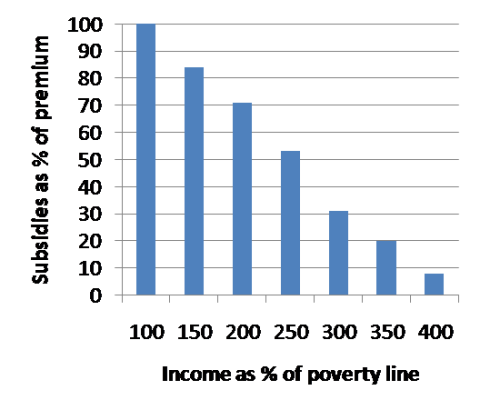
Paul Krugman gives us this graph from the Kaiser Health Reform Subsidy Calculator


It's pretty clear reform would make health care much more accessible to those at the lower end of the economic spectrum. In fact, for those at or below the poverty line, reform will practically pay for your health insurance. From a progressive standpoint, not bad at all. Now, of course tiered subsidy rates can cause perverse incentives, depending on what's lost between the move from say, 100% and 150% of the PL. But those potential problems aside, I'd say this is pretty cool.

Saturday, December 26, 2009

Strange Bedfellows

By Dave

Strange bedfellows indeed. Jane Hamsher at FireDogLake recently joined forces with Grover Norquist to call on Eric Holder to investigate Obama Chief of Staff Rahm Emanuel. Let me repeat: super-"progressive" blogger Jane Hamsher has joined forces with Grover Motherf%$king Norquist to attack Obama’s Chief of Staff.

Now I already don't care much for Hamsher because for her asinine, misleading, and frankly idiotic 10 Reasons to kill the Health Care Bill. Every reason seems designed to completely misrepresent what this bill does. It's almost as bad as talking to a teabagger! Anyways, Ezra Klein offers a solid rebuttal.

So what's this petition about? According to ABC, accounting fraud took place at Fannie Mae from about 1998-2002. Here's the SEC complaint. Rahm Emanuel served on the board of Fannie Mae from 2000-2001.  The Office of Federal Housing Enterprise Oversight (OFHEO) report was very critical of the Board of Directors but also said, "the terms of the presidentially appointed Directors are far too short, averaging just over 14 months, for them to play a meaningful role on the Board." Although a number of people were charged, Emanuel was not. So should Rahm be investigated again? I don't know. Hamsher thinks there is still something there, so whatever, I've really got no beef with this.

What I can't get over is that she's teamed up with Grover Norquist. You remember him. The same guy who called bipartisanship a form of date rape. The same guy who was College Republic pals with Karl Rove. The same guy who said Democrats will only be acceptable once they “are comfortable in their minority status. Any farmer will tell you that certain animals run around and are unpleasant, but when they’ve been fixed, then they are happy and sedate.” The same guy who wants to drown the government in a bathtub. The guy who said Obama was "John Kerry, with a tan." Perhaps you remember this little gem: ""Our goal is to inflict pain. It is not good enough to win; it has to be a painful and devastating defeat. We're sending a message here. It is like when the king would take his opponent's head and spike it on a pole for everyone to see."

This is not 'politics make strange bedfellows', this is just stupid. And suicidal. Do you remember the Clinton years? Guys like Norquist wage politics as war. They take no prisoners. They will take any and every opportunity to destroy the progressive agenda and return us to the Bush years. You may find confluence on an issue, but they will leverage that means to a different ends. Don't give them credibility, don't give them a platform, don't give them an audience.

I'm sorry but Hamsher is out of her mind. This is like teaming up with Dick Cheney because you don't like the President's Afghan policy or cowriting Facebook pages with Sarah Palin because you don't like the President's Energy Policy. Maybe she'll cowrite an op-ed in the Wall Street Journal with Karl Rove next.

(Picture from Spiegel Online: http://www.spiegel.de/international/0,1518,grossbild-1488841-618181,00.html)